
Urbanie & Urbanus
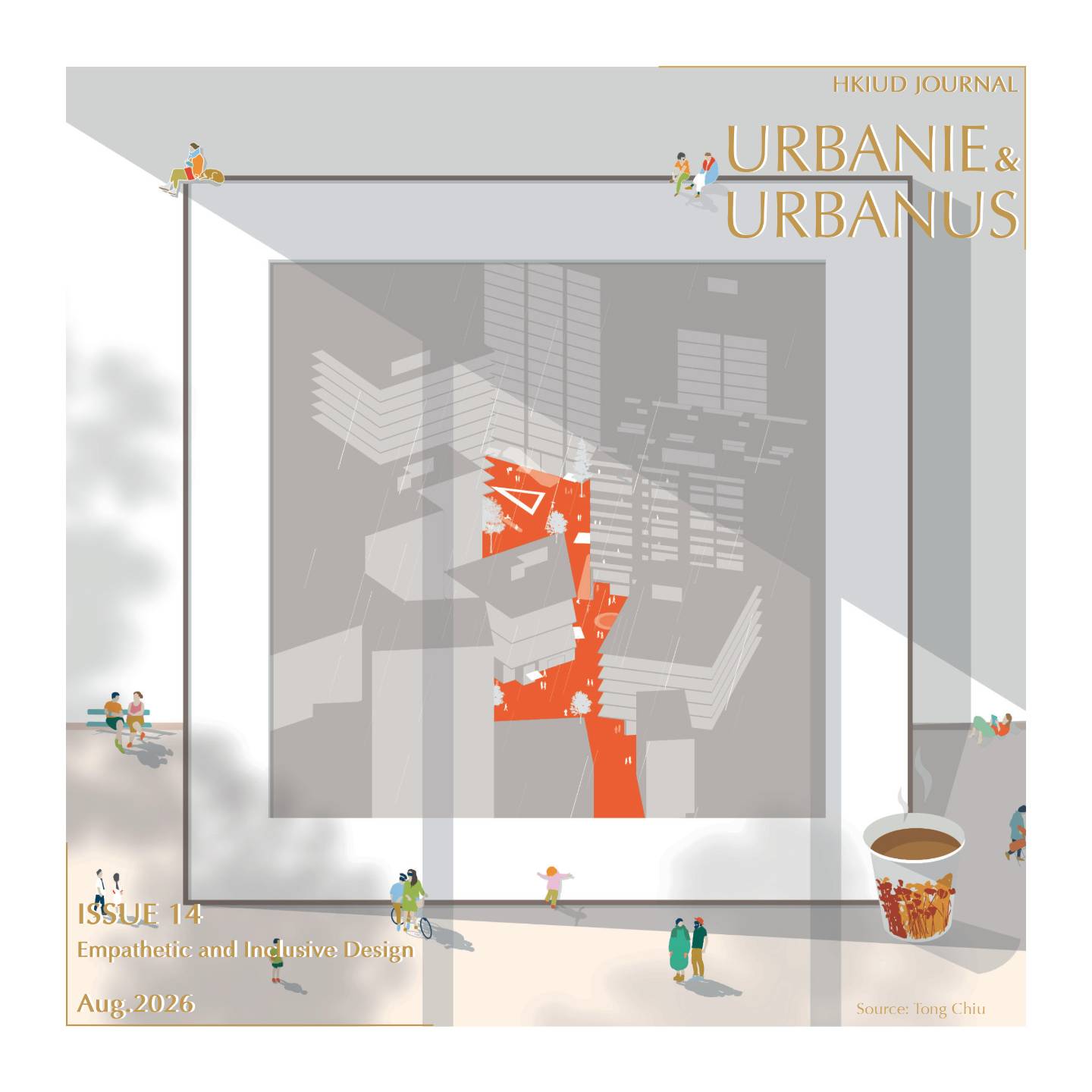
Issue 2026 Aug
Empathetic and Inclusive Design
Editor’s Note
What does it mean to design with empathy? Too often, empathy is reduced to comfort—smoothing edges, removing obstacles, and rendering spaces frictionless. Yet the papers in this issue suggest a more demanding, generative vision: empathy as a willingness to sit with difference, embrace incompletion, and design for the messy, lived realities of urban life.
Tony Chiu opens this conversation by arguing that dense urbanism loses something vital when care degenerates into comfort management. His design studies in Wan Chai and Sheung Shui embrace friction, variety, and memory as social infrastructure—spatial generosity that enables genuine coexistence rather than mere convenience. This theme echoes throughout the issue. Khalil and Choi interrogate the rise of AI-simulated users, warning that synthetic empathy can harden into unquestioned design requirements unless provenance and contestation are built directly into the process. Shen, Chan, and van Ameijde turn to Hong Kong’s informal street culture, where buskers, artists, and community gatherings reclaim narrow public spaces as arenas of expression—constantly negotiating the boundary between control and creativity. Choi, Tse, and Lo extend empathy to materials, showing how upcycled IKEA wood waste can foster local skills and social connection through circular design. Portugali offers a holistic, phenomenological lens, reminding us that architecture is ultimately built for living people, not abstract concepts. Liao and Ho examine Hong Kong’s wet markets, proposing adaptive spatial interventions that respond to the authentic rhythms of supply, accessibility, and daily routine. Li, Lyu, and Qiu add a methodological perspective, using computer vision and space syntax to reveal age-differentiated behaviours in tourist plazas, offering a transferable framework for designing public squares that respond to the diverse needs of children, adults, and older adults alike.
Together, these works reframe empathy as a practice of deep attention—to users, to materials, to memory, and to the informal systems that sustain urban life. They challenge us to design not for a frictionless world, but for one where productive friction, spatial negotiation, and true belonging remain possible. We hope this issue inspires readers to imagine empathy not as a soft ideal, but as a rigorous, spatial, and deeply human practice.
We are also delighted to welcome two distinguished scholars to our editorial board: Professor Jeroen van Ameijde from The Chinese University of Hong Kong and Dr. Han Hsi Ho from The University of Hong Kong. Both bring critical insights to the U+U journal, and their expertise will greatly enrich our ongoing scholarly dialogue.