
Urbanie & Urbanus
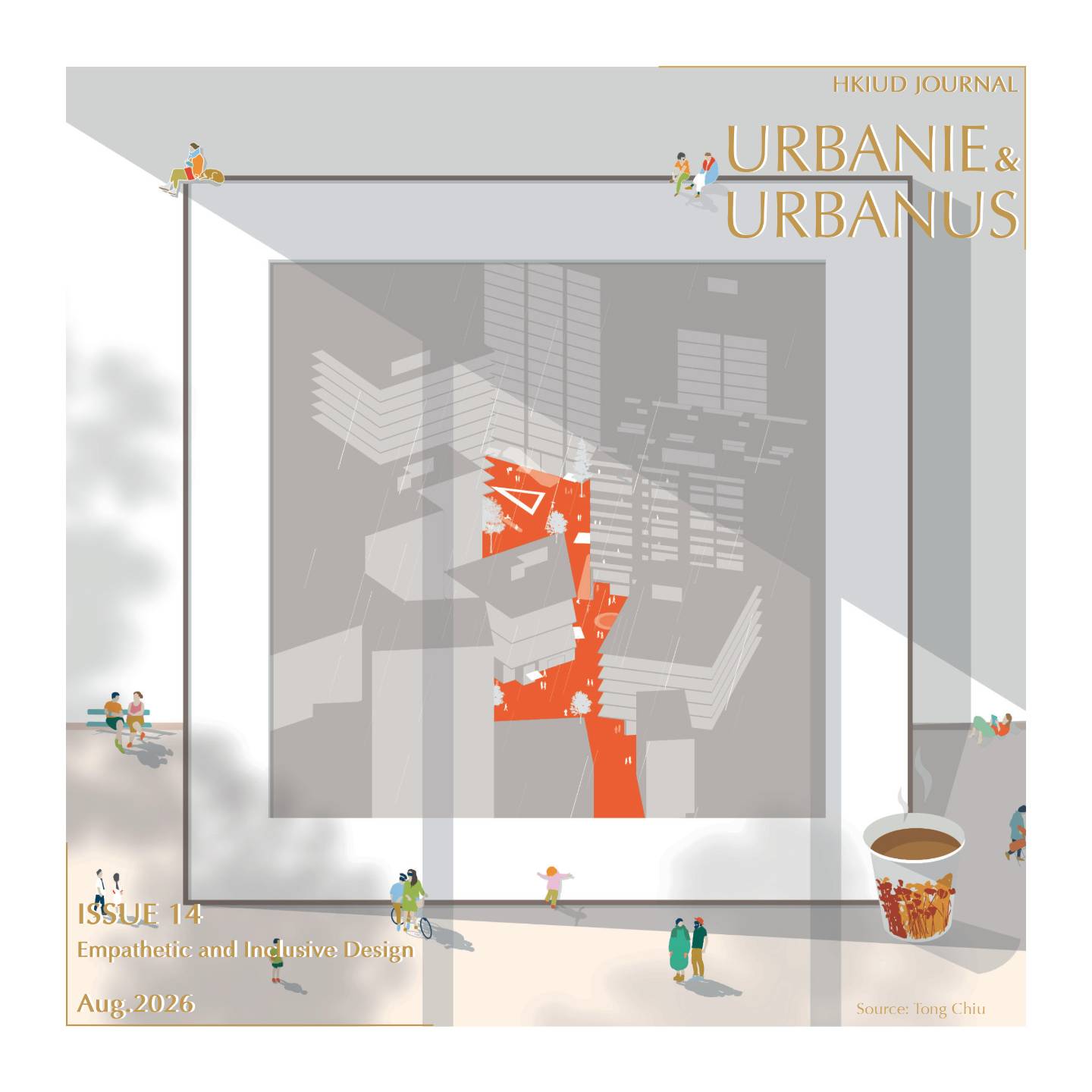
Issue 2026 Aug
Empathetic and Inclusive Design
Issue 14, P. - P.
From Waste to Re:Design — Interdisciplinary Pathways for Sustainable Upcycling of IKEA Wood Waste
References
- Altman, I., & Low, S. M. (Eds.). (1992). Place attachment. Plenum Press.
Anderson, B. (2014). Encountering affect: Capacities, apparatuses, conditions. Ashgate.
Aspinall, P., Mavros, P., Coyne, R., & Roe, J. (2015). The urban brain: Analysing outdoor physical activity with mobile EEG. British Journal of Sports Medicine, 49(4), 272–276.
Bechara, A., Damasio, H., Tranel, D., & Damasio, A. R. (1997). Deciding advantageously before knowing the advantageous strategy. Science, 275(5304), 1293–1295.
Bellmund, J. L., Gärtner, B. O., Rueckert, E., & Doeller, C. F. (2018). Deforming the metric structure of cognitive maps distorts navigation. eLife, 7, e37764.
Berthoz, A. (2000). The brain's sense of movement. Harvard University Press.
Bocken, N. M. P., de Pauw, I., Bakker, C., & van der Grinten, B. (2016). Product design and business model strategies for a circular economy. Journal of Industrial and Production Engineering, 33(5), 308–320.
Böhme, G. (1993). Atmosphere as the fundamental concept of a new aesthetics. Thesis Eleven, 36(1), 113–126.
Botsman, R., & Rogers, R. (2010). What's mine is yours: How collaborative consumption is changing the way we live. Collins.
Brenner, N., Marcuse, P., & Mayer, M. (Eds.). (2012). Cities for people, not for profit: Critical urban theory and the right to the city. Routledge.
Bullard, R. D. (2008). Dumping in Dixie: Race, class, and environmental quality (3rd ed.). Westview Press.
Checker, M. (2011). Polluted promises: Environmental racism and the search for justice in a Southern town. NYU Press.
Colls, R. (2012). Feminism, bodily difference and non-representational geographies. Transactions of the Institute of British Geographers, 37(3), 430–445.
Cresswell, T. (1996). In place/out of place: Geography, ideology, and transgression. University of Minnesota Press.
Crane, L., Goddard, L., & Pring, L. (2009). Sensory processing in autism spectrum disorders. Autism, 13(3), 215–216.
Cradle to Cradle Products Innovation Institute. (2020). Cradle to Cradle Certified® Product Standard. Version 4.0.
Cullen, K. E. (2012). The vestibular system and sensorimotor performance. Annual Review of Biomedical Engineering, 14, 69–87.
D'Andrea, A. (2006). Global nomads: Techno and new age as transnational countercultures in Ibiza and Goa. Routledge.
Damasio, A. R. (1994). Descartes' error: Emotion, reason, and the human brain. Grosset/Putnam.
Ellen MacArthur Foundation. (2013). Towards the circular economy: Economic and business rationale for an accelerated transition. Ellen MacArthur Foundation.
Ellen MacArthur Foundation. (2017). Circular design: The handbook for circular makers and systems designers. Ellen MacArthur Foundation.
Ellen MacArthur Foundation. (2020). The circular economy and the concept of the circular business model. Ellen MacArthur Foundation.
Epstein, R. A. (2008). Parahippocampal and retrosplenial contributions to three-dimensional spatial cognition. Nature Reviews Neuroscience, 9(12), 871–882.
European Commission. (2020). A new Circular Economy Action Plan for a cleaner and more competitive Europe. Retrieved from https://ec.europa.eu/environment/circular-econom
Ferreri, L., Trebbi, E., Dondé, C., Adés, J., & Poirier, M.-F. (2019). Emotional contagion and empathy in music listening. Frontiers in Psychology, 10, 1104.
Fletcher, K., & Grose, L. (2012). Fashion and sustainability: Design for change. Laurence King Publishing.
Forty, A. (2014). Objects of desire: Design and society since 1750. Thames & Hudson.
Fuad-Luke, A. (2009). Design activism: Beautiful staircase in the age of mass production. Routledge.
Geissdoerfer, M., Savaget, P., Bocken, N. M. P., & Hultink, E. J. (2017). The Circular Economy — A new sustainability paradigm? Journal of Cleaner Production, 228(1), 757–768.
Gehl, J. (2011). Life between buildings: Using public space (6th ed.). Island Press.
Golledge, R. G., & Stimson, R. J. (1997). Spatial behavior: A geographic perspective. The Guilford Press.
Harvey, D. (1990). The condition of postmodernity: An enquiry into the origins of cultural change. Blackwell
Harvey, D. (2012). Rebel cities: From the right to the city to the urban revolution. Verso.
Hobson, K. (2016). Closing the loop or squaring the circle?循环 stocktaking on circular economy and daily life. Journal of Industrial Ecology, 20(4), 943–945.
Howes, D. (2005). Empire of the senses: The sensual culture reader. Berg.
IKEA Foundation. (2019). Circular business initiative: Recovering value from returns and waste. Internal Report.
International Resource Panel (UNEP). (2019). Global resources outlook 2019: Natural resources for the future we want. United Nations Environment Programme.
Jacobson, R. D., & Kitchin, R. M. (2016). Cognitive mapping abilities with technology. Journal of Visual Impairment & Blindness, 110(5), 333–344.
Jonsson, H. (2020). IKEA's circular economy journey: From linear supply chains to systems thinking. Sustainable Business Review, 15(3), 234–251.
Julier, G. (2017). From design culture to design activism. Design and Culture, 9(2), 105–122.
Kafer, A. (2013). Feminist, queer, crip. Oxford University Press.
Kaplan, R., & Kaplan, S. (1989). The experience of nature: A psychological perspective. Cambridge University Press.
Kirchherr, J., Reike, D., & Hekkert, M. (2017). Conceptualizing the circular economy: An analysis of 114 definitions. Resources, Conservation and Recycling, 127, 221–232.
Kitchin, R. M. (1994). Cognitive maps: What are they and why study them? Journal of Environmental Psychology, 14(1), 1–19.
Kitchin, R., & Thrift, N. (2009). International encyclopedia of human geography. Elsevier.
Kun, D., & Pukánszky, B. (2005). Polymer/lignin blends: Interactions, properties, applications. Progress in Polymer Science, 30(8–9), 1143–1190.
Kusenbach, M. (2003). Street phenomenology: The go-along as ethnographic research method. Ethnography, 4(3), 455–485.
Lakoff, G., & Johnson, M. (2003). Metaphors we live by (2nd ed.). University of Chicago Press.
Latour, B. (2004). Politics of nature: How to bring the sciences into democracy. Harvard University Press.
Laurier, E., & Philo, C. (2006). Cold shoulders and overheated streets: The politics of streetworking in Edinburgh's new town. Area, 38(2), 192–202.
Lederman, S. J., & Klatzky, R. L. (2009). Haptic perception: A tutorial. Attention, Perception, & Psychophysics, 71(7), 1439–1459.
Lefebvre, H. (1991). The production of space. Blackwell.
Lewicka, M. (2011). Place attachment: How far have we come in the last 40 years? Journal of Environmental Psychology, 31(3), 207–230.
Longhurst, R. (2001). Bodies: Exploring fluid boundaries. Routledge.
Low, S. M., & Altman, I. (1992). Place attachment: A conceptual inquiry. In I. Altman & S. M. Low (Eds.), Place attachment (pp. 1–12). Plenum Press.
Lynch, K. (1960). The image of the city. MIT Press.
Maguire, E. A., Friston, K. A., Frackowiak, R. S., & Ashburner, J. (2006). Navigation expertise and the human hippocampus: A structural brain imaging analysis. Hippocampus, 13(2), 250–259.
Manzini, E. (2015). Design, when everybody designs: An introduction to design for social innovation. MIT Press.
Manzini, E., & Vezzoli, C. (2003). A strategic design approach to develop sustainable product service systems: Examples taken from the "environmentally friendly innovation" Italian prize. Journal of Cleaner Production, 11(8), 851–857.
Massey, D. B. (1994). Space, place and gender. University of Minnesota Press.
Massumi, B. (2002). Parables for the virtual: Movement, affect, sensation. Duke University Press.
McDonough, W., & Braungart, M. (2002). Cradle to cradle: Remaking the way we make things. North Point Press.
McDowell, L. (1999). Gender, identity and place: Understanding feminist geographies. University of Minnesota Press.
McQuire, S. (2008). The media city: Media, architecture and urban space. SAGE.
Miller, D. (1987). Material culture and mass consumption. Blackwell.
Moreno, M., De los Rios, I., Rowe, Z., & Charnley, F. (2016). A conceptual framework for circular design. Sustainability, 8(9), 937.
Murray, R. (2002). Zero waste. Environment and Planning A, 34(2), 191–212.
Noë, A. (2004). Action in perception. MIT Press.
O'Keefe, J., & Nadel, L. (1978). The hippocampus as a cognitive map. Oxford University Press.
Palmer, S. E., & Schloss, K. B. (2010). An ecological valence theory of human color preference. Proceedings of the National Academy of Sciences, 107(19), 8877–8882.
Papanek, V. J. (1971). Design for the real world: Human ecology and social change. Pantheon Books.
Passini, R. (1984). Wayfinding in architecture. Van Nostrand Reinhold.
Portugali, J. (Ed.). (2000). The construction of cognitive maps. Kluwer Academic Publishers.
Portugali, J. (2011). Complexity, cognition and the city. Springer.
Ragauskas, A. J., Beckham, G. T., Biddy, M. J., et al. (2014). Lignin valorization: Improving lignin processing in the biorefinery. Science, 344(6185), 1246843.
Rose, G. (1993). Feminism & geography: The limits of geographical knowledge. University of Minnesota Press.
Schultz, J. (2020). Confronting the circular economy: Justice and sustainability in the waste management system. Capital Nature Socialism, 31(2), 156–174.
Seamon, D. (1979). A geography of the lifeworld: Phenomenological perspectives on global haunt. Croom Helm.
Shove, E., & Pennell, N. (1999). On the objects of study and the subjects of study. In E. Shove & N. Pantzar, Manufacturing leisure: Innovations in happiness, well-being and fun (pp. 21–48). Routledge.
Stamps, A. E. (2005). Enclosure and safety in urban street sections. Journal of Urban Design, 10(1), 61–78.
Stahel, W. R. (2016). The circular economy. Nature, 531(7595), 435–438.
Thompson, E., & Varela, F. J. (2001). Radical embodied cognitive science. Trends in Cognitive Sciences, 5(11), 418–425.
Thrift, N. (2008). Non-representational theory: Space, politics, affect. Routledge.
Tilley, C. (1994). A phenomenology of landscape: Places, paths and monuments. Berg.
Turnbull, D. (2000). Masons, tricksters and cartographers: Comparative studies in the sociology of scientific and indigenous knowledge. Harwood Academic.
Valentine, G. (1989). The geography of women's fear. Area, 21(4), 385–390.
Varela, F. J., Thompson, E., & Rosch, E. (1991). The embodied mind: Cognitive science and human experience. MIT Press.
Veitch, J. A., & McColl, S. L. (1994). Modulation of fluorescent light: Flicker rate and light source effects on visual performance and visual comfort. Lighting Research and Technology, 27(4), 243–256.
Whitehead, A. N. (2007). Process and reality: An essay in cosmology (Corrected ed.). Free Press.
Williams, D. R., Patterson, M. E., Roggenbuck, J. W., & Watson, A. E. (1992). Beyond just use: Value, obligation and discontinuity to outdoor recreation. Journal of Leisure Research, 24(4), 335–350.
Zink, T., & Geyer, R. (2017). Circular economy rebound. Journal of Industrial Ecology, 21(3), 593–602.
Zuboff, S. (2019). The age of surveillance capitalism: The fight for a human future at the new frontier of power. PublicAffairs.